

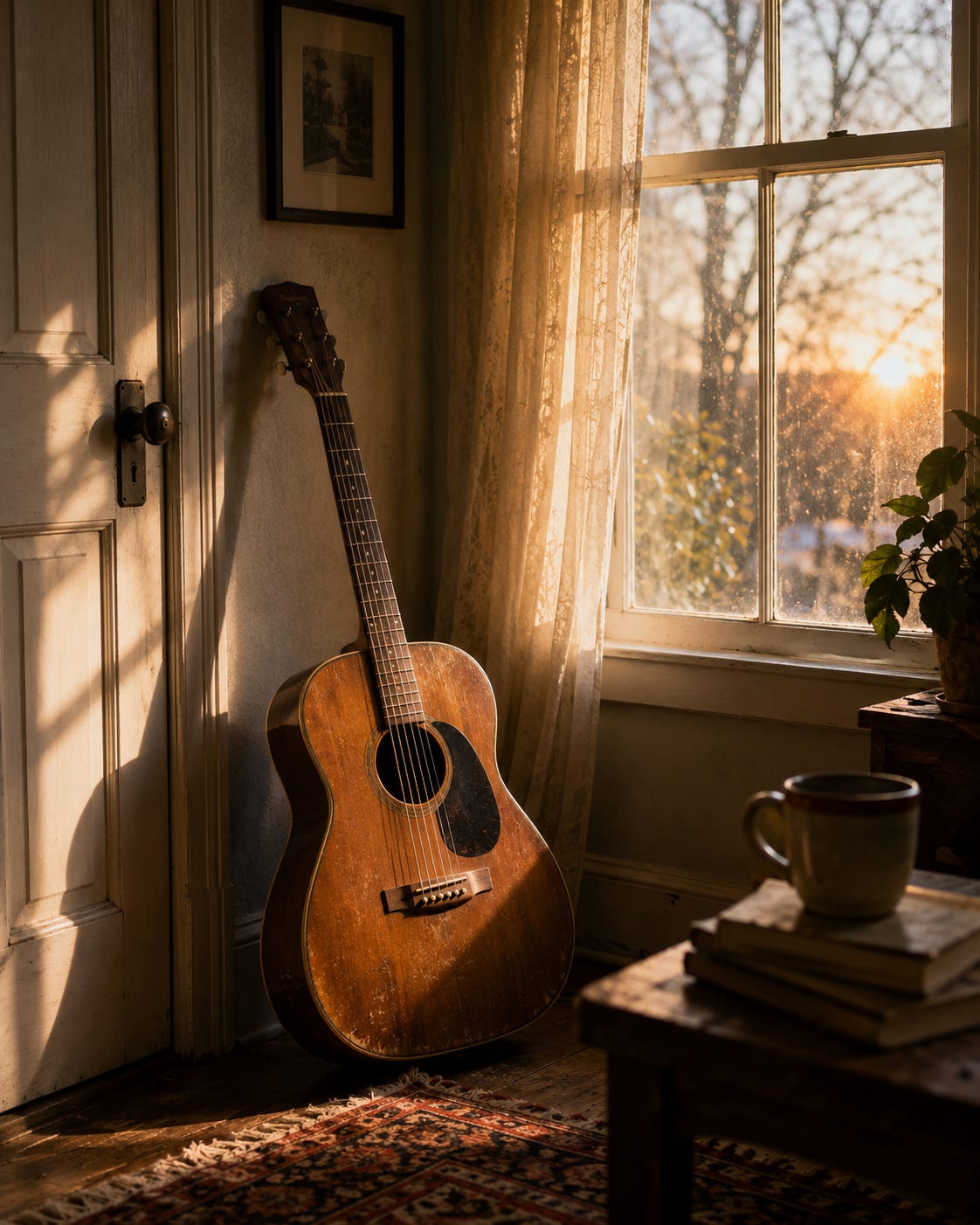
My D’Angelico sits in the corner,
a dusty relic
leaning against the wall
like an old college friend
I’ve neglected too long.
My brother gave it to me
after the fires.
A real guitarist
the kind who can make
six strings
tell stories
I can only write down.
He was certain
I would play,
certain
I would sing,
certain, perhaps,
the music
would find me.
Instead,
it found a corner
in the living room
by the front door
where it stares out the window.
Sometimes I catch myself
staring at it.
Sometimes I find it
staring back.
Every time I look at it,
I feel a small tug of guilt.
Not enough to pick it up.
Just enough to look away.
The strings are out of tune.
And so am I.
It wonders if I still remember
the chords to Big Yellow Taxi
or That’ll Be the Day,
asking if seventy
is too late
to sing again.
There are notes
I can no longer bring myself to touch.
The Irish lullaby I sang
to my daughters.
The songs tied
to people
who are gone.
The melodies that hurt.
Ghost notes —
soft omissions.
small hauntings
between the chords.
But this morning,
I cross the room.
Lift the guitar
from its corner.
Wipe away the dust.
The wood feels familiar,
though we have
barely spoken
in years.
My fingers hesitate.
Then find a chord.
It vibrates.
The second
one is worse.
The third
isn’t much better.
I laugh.
The guitar doesn’t care.
It has been waiting
all this time,
patient as a brother
who believes in me
long after I’ve stopped
believing in myself.
The missing notes
are still missing.
They always will be.
But there are songs
left to play.
And maybe
this is enough.
Notas Fantasma
Mi D’Angelico descansa en un rincón,
una reliquia cubierta de polvo,
apoyada contra la pared
como un viejo amigo de la universidad
al que he descuidado demasiado tiempo.
Mi hermano me la regaló
después de los incendios.
Un guitarrista de verdad,
de esos que logran que
seis cuerdas
cuenten historias
que yo solo sé escribir.
Estaba convencido
de que tocaría,
convencido
de que cantaría,
convencido, quizás,
de que la música
terminaría encontrándome.
En cambio,
encontró un rincón
en la sala,
junto a la puerta de entrada,
desde donde mira por la ventana.
A veces me sorprendo
mirándola.
A veces siento
que ella me devuelve la mirada.
Cada vez que la veo,
siento un leve tirón de culpa.
No lo bastante fuerte
como para levantarla.
Solo lo suficiente
para apartar la vista.
Las cuerdas están desafinadas.
Y yo también.
Se pregunta si todavía recuerdo
los acordes de Big Yellow Taxi
o de That’ll Be the Day,
preguntándose
si a los setenta
es demasiado tarde
para volver a cantar.
Hay notas
que ya no puedo obligarme a tocar.
La nana irlandesa
que les cantaba a mis hijas.
Las canciones ligadas
a personas
que ya no están.
Las melodías que duelen.
Notas fantasma…
omisiones suaves,
equeñas apariciones
entre los acordes.
Pero esta mañana
cruzo la habitación.
Levanto la guitarra
de su rincón.
Le quito el polvo.
La madera me resulta familiar,
aunque apenas
hayamos hablado
en años.
Mis dedos vacilan.
Luego encuentran un acorde.
Vibra.
El segundo
suena peor.
El tercero
no mejora mucho.
Me río.
A la guitarra no le importa.
Ha estado esperando
todo este tiempo,
paciente como un hermano
que sigue creyendo en mí
mucho después
de que yo dejara
de creer en mí mismo.
Las notas perdidas
siguen perdidas.
Siempre lo estarán.
Pero aún quedan canciones
por tocar.
Y quizá
eso sea suficiente.
The line “The strings are out of tune. And so am I.” stayed with me. But what moved me most was the guitar waiting without judgment, almost carrying the brother’s faith through all those silent years. Sometimes beginning again is not about recovering every lost note. It is simply about allowing one chord to sound.